Dual Diploma Switzerland
An American diploma programme had to make sense to Swiss families. We designed and built the site from scratch, in four languages, with an application form that follows the programme’s official structure.
- Type
- Education
- Year
- 2025
- Scope
- Website design, WordPress build and a multi-step application form
- Languages
- English, German, French and Italian
- Live site
- dualdiploma-switzerland.ch ↗
New site and wireframes
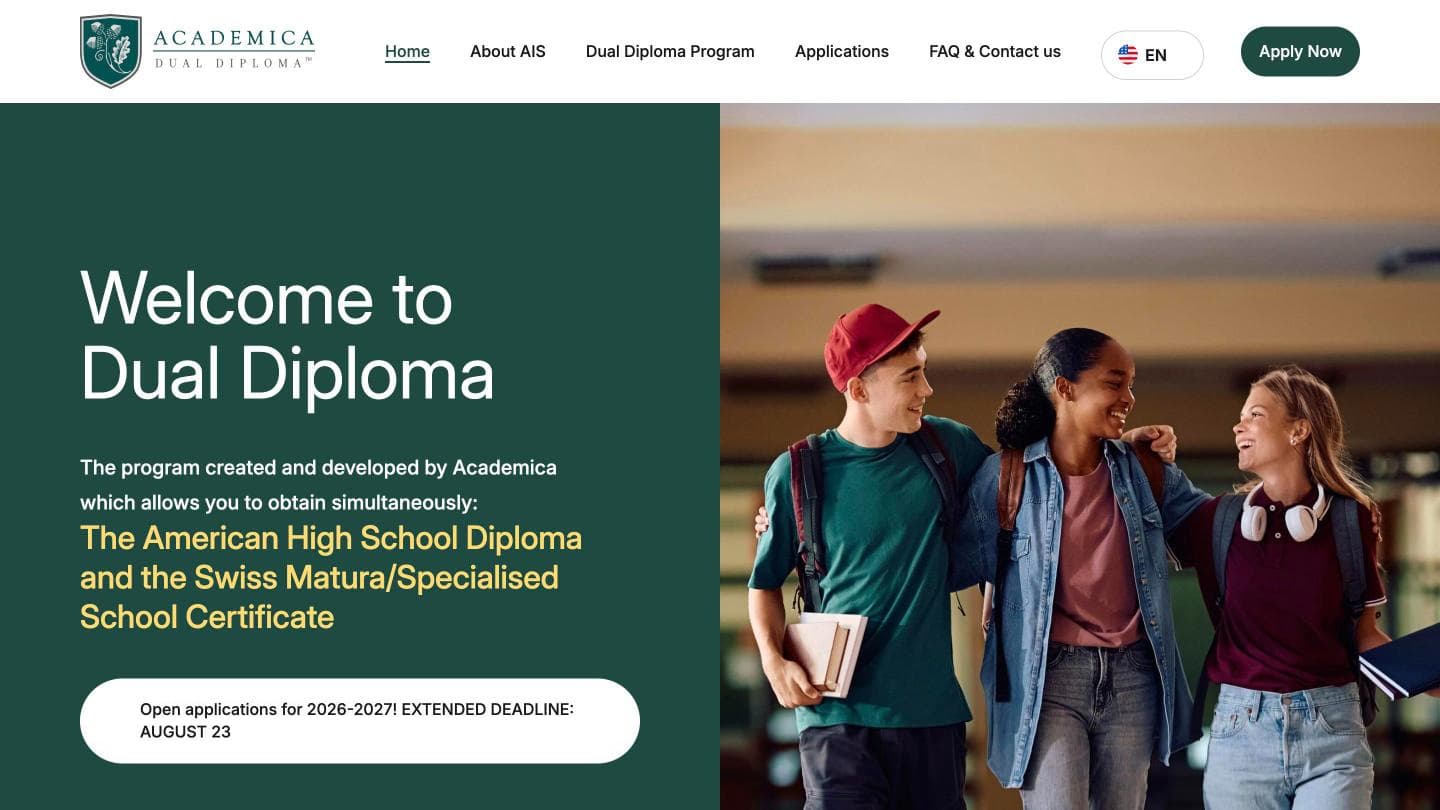
 New site
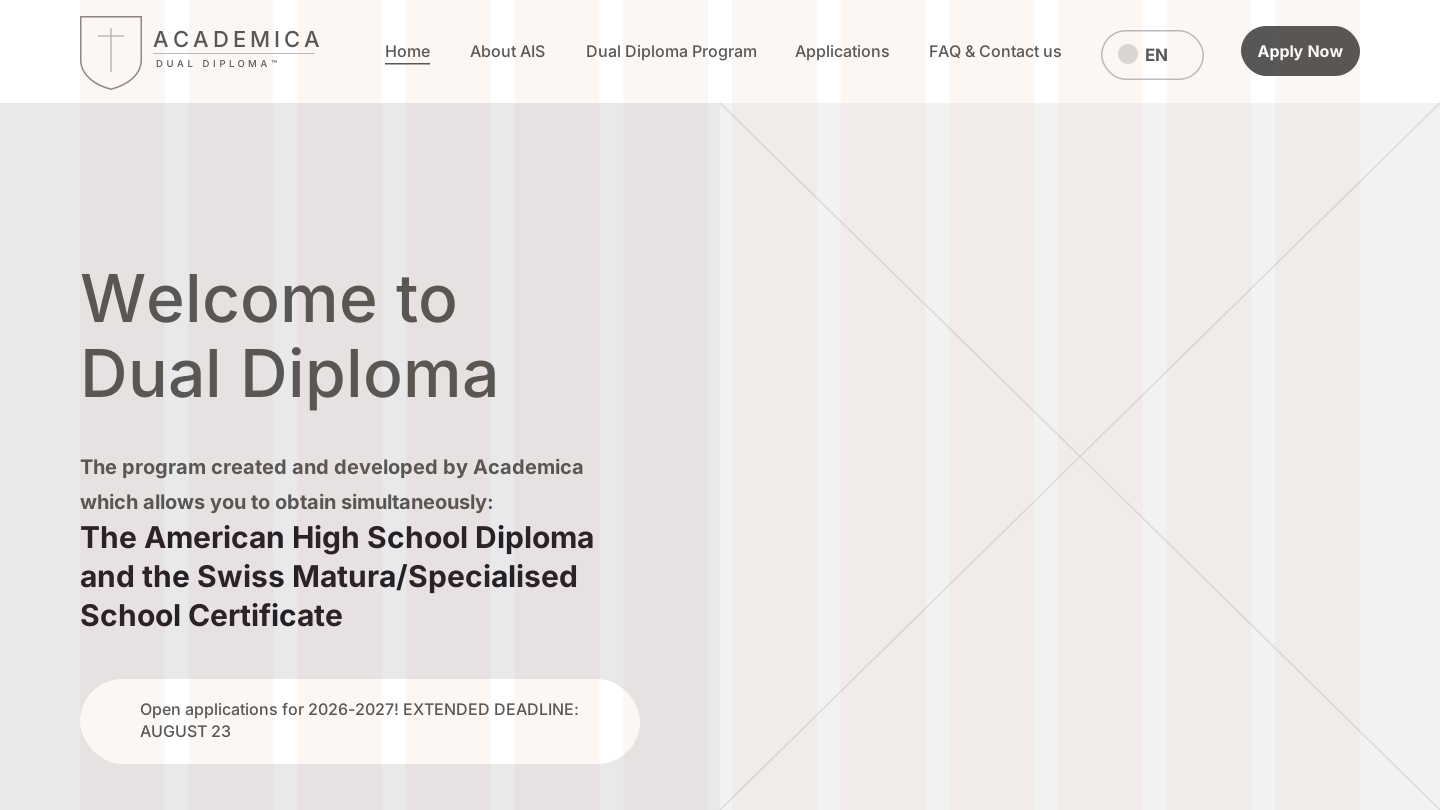
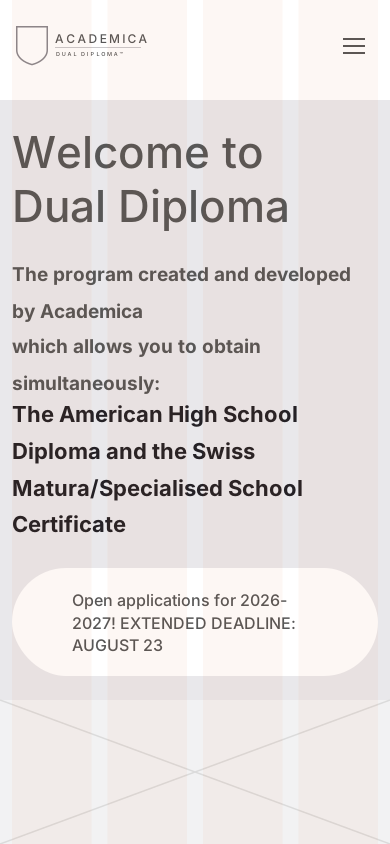 Detailed wireframe
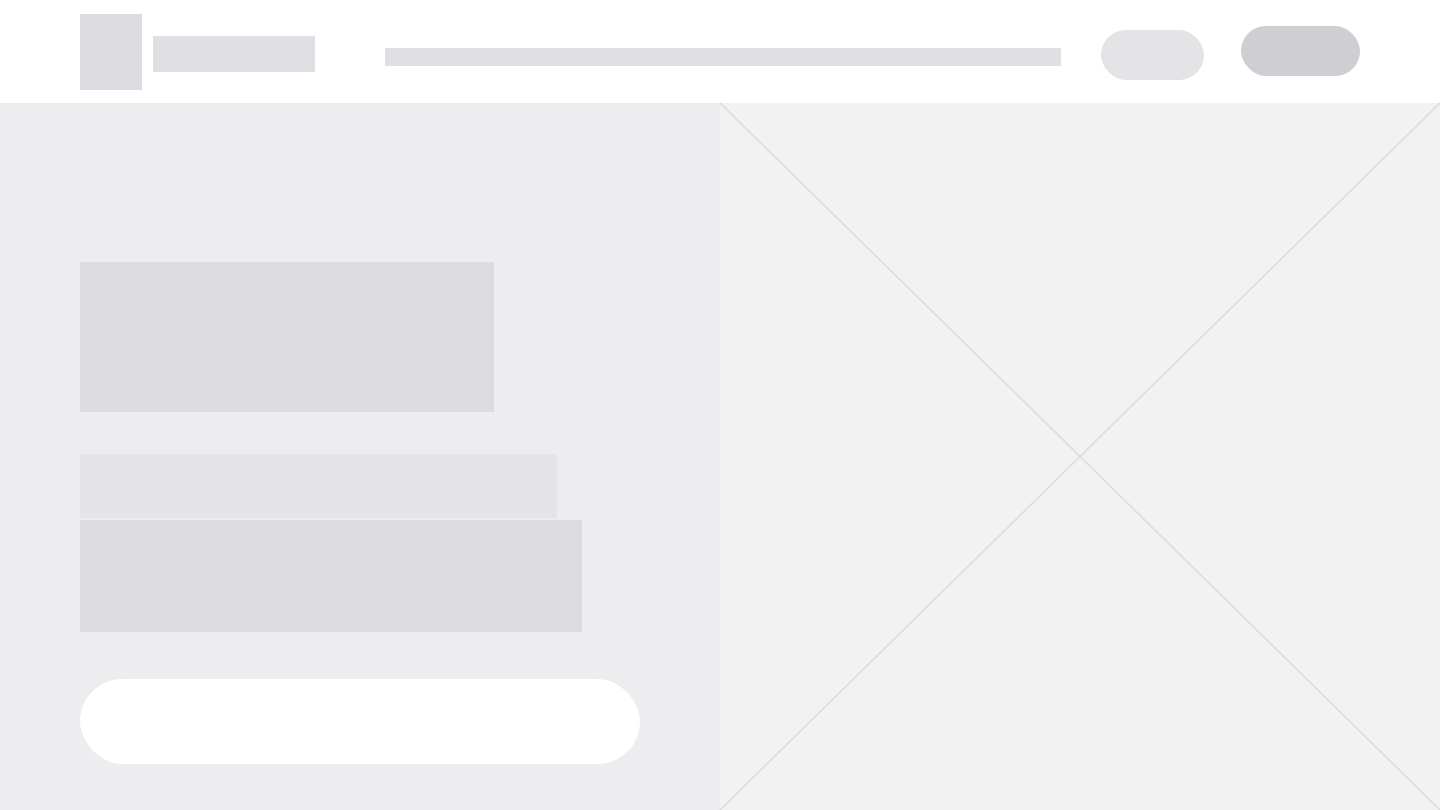
 Rough wireframe
- Languages, because Swiss families read German, French, Italian and English
- 4
- Short steps in the application form, in place of one long page of around 40 details
- 5
- Credits validated from the Swiss transcript, the sum the site has to explain
- 18/24
How it came about
The Dual Diploma lets Swiss students earn the American High School Diploma alongside the Swiss Matura or Specialised School Certificate. Academica, the American education group behind it, runs the programme internationally.
The work came to us by referral. Switzerland needed a site of its own, because the offer only makes sense in Swiss terms: cantons, school years and Swiss francs.
There was no site to start from, so we designed and built one from scratch.
The research
Three things about the audience shaped the site.
Families decide together, over a long time
This is two to four years of extra study alongside normal school, so the site has to answer detailed questions before anyone applies.
Switzerland has several school systems
The programme fits differently by canton, so the site sets out model tables by canton and school year.
Switzerland has several languages
In 2023, 66% of residents named German as a main language, 23% French and 8% Italian, while 6% named English. A site in one language would miss most of its families.
The design
A family is trusting a school with years of a child’s study. The design had to look established, and it had to make a complicated offer simple on the first screen.
Why green and yellow
The colours come from the Academica crest, so the Swiss site reads as part of an established American institution.
Why text and photograph sit side by side
The first screen splits in two: the promise on solid green, the students beside it. Nothing is printed over the photograph, so the words stay sharp on any photo and any screen. White on the green reaches a contrast of 9.9 to 1 and the yellow 7.4 to 1, both past the 7 to 1 of WCAG’s highest level.
Why the two diplomas get the yellow
One line on the first screen is in colour: the American High School Diploma and the Swiss Matura. That is the whole offer, so it is what a visitor should remember.
Why this photograph
The programme is studied online, and a parent’s natural fear is that online means alone. So the first picture is three students laughing together. In eye-tracking research, Moran Cerf and colleagues found that faces and text draw the eye far more than other parts of an image, so the first screen holds just those two things.
Why the sum is spelled out
24 credits are needed, 18 are validated from the Swiss transcript, and 6 are studied online. The page walks through that sum because it is the main thing a parent has to believe.
Why Apply Now is always there
The button sits in the header of every page, so a family that has decided never has to look for it.
The wording
The words were written by the client, who knows the families and the Swiss system.
Why the site uses Swiss terms
It says Matura, Specialised School Certificate, 10VP/VG and canton of Vaud, because those are the words families use. Prices appear in Swiss francs first, with US dollars beside them.
How the four languages were made
The translations were produced with an AI language model, then the German and Italian were corrected by native speakers.
The build
Build a custom theme
A custom WordPress theme lets the client update most of the site without a developer.
Split the form into five steps
The form asks for around 40 details, so it is split into five short steps: student, address, first guardian, second guardian and schooling. Research on the goal-gradient effect (Kivetz and colleagues, 2006) found that people put in more effort as they see themselves getting closer to a goal, and each finished step is visible progress.
Follow the official structure
The form began from the client’s Google Form and was rebuilt in October 2026 to match what Academica International Studies requires.
Send applications to a Swiss address
Every application goes straight to the programme’s own Swiss inbox.
Stay on after launch
We have kept supporting the site since launch, with fee tables, social links, press coverage and canton model tables.
The result
A live site in four languages, run day to day by the client, with an application form built to the programme’s official structure.
The programme has been covered in the Swiss newspaper La Côte, and the site links to the article.
What we learned
- Build for the person who edits the site. The year on the form was fixed inside the form plugin, and the fee table needed a developer to change. Small updates that come round every year should be in the client’s hands from the start.
- Build forms from the official rules. The form began from what the client had. When the official structure had to be followed, fields moved and new ones were added. Starting from that structure would have saved the rebuild.
- AI translation is a first draft. It gave the site four languages quickly and at low cost, but native speakers still had to correct it. Any translation budget should include that step.
Standards met
- Text contrast
- Calculated from the site’s own colours: white on green 9.9 to 1, and yellow on green 7.4 to 1.
- Languages
- English, German, French and Italian.
- Editing
- Pages are edited in WordPress by the client.
Sources
- Swiss Federal Statistical Office figures for 2023, reported by SWI swissinfo.ch, 2025
- Cerf, Frady and Koch, Faces and text attract gaze independent of the task, Journal of Vision 9(12), 2009
- Kivetz, Urminsky and Zheng, The Goal-Gradient Hypothesis Resurrected, Journal of Marketing Research 43, 2006
- W3C, Web Content Accessibility Guidelines (WCAG) 2.2, 2023
Team
- Project lead
- Matthew Bowman
- Client team
- Dual Diploma Switzerland
What this platform could carry next
What this proves
We explain an offer in local terms.
An American programme reads as a Swiss one: cantons, school years and Swiss francs, in four languages.
We make long forms feel short.
Around 40 details became five short steps that follow the programme’s official structure.
We stay after launch.
The site has kept changing with the programme, with fee tables, form changes and press coverage added since it went live.
Contact
Send us the brief.
A rough brief or a terms of reference is enough. Matthew Bowman replies the same business day, and you have a fixed-fee proposal within five working days.